

Shopping for groceries these days is an exercise in controlling rage.
The prices of most food items have gone bananas (including bananas).
It’s easy to blame the supermarket, but the truth is grocery stores have notoriously razor-thin margins.
The average supermarket generates around $37 million a year in revenue but has a profit margin of just 1.7%.
Kroger (NYSE: KR), one of the largest supermarket chains, reported a minuscule 0.7% profit margin in fiscal 2025, which ended in January.
Can the grocery giant continue to pay its dividend when it barely makes a profit on every chicken breast, box of cereal, and bag of chips that it sells?
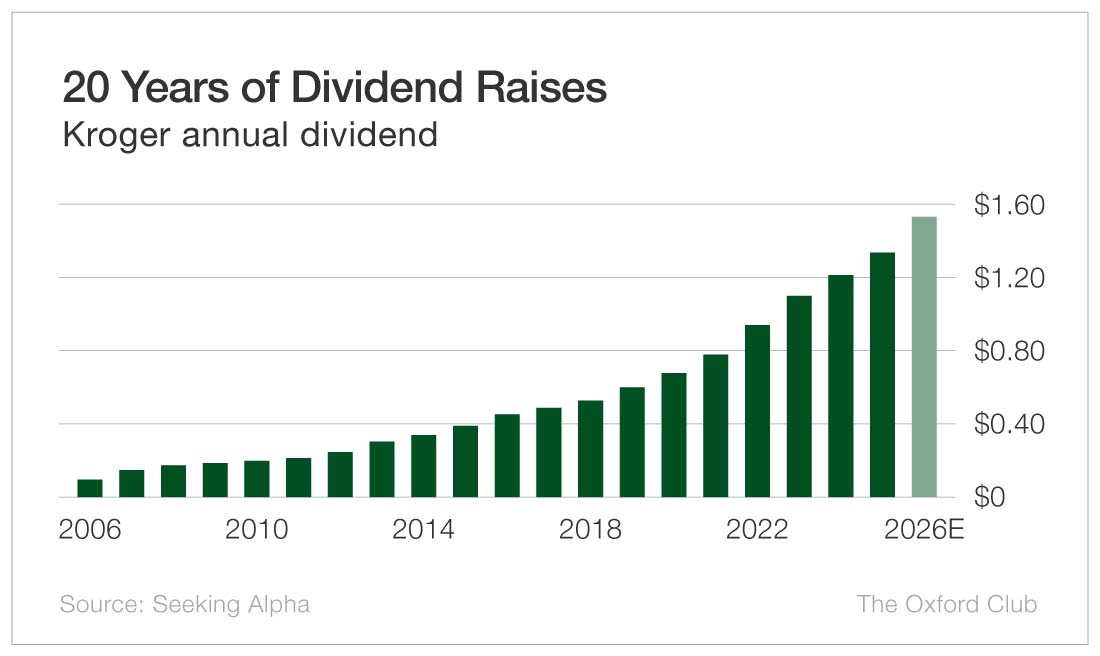
Kroger currently pays a $0.39 per share quarterly dividend, which comes out to an annual yield of 2.7%. It has raised its dividend every year since 2007.
In fiscal 2025, free cash flow nearly doubled to $3.5 billion as the cost of an asset write-down was added back into free cash flow.
When a company writes down or writes off an asset that has declined in price, it affects earnings, but it doesn’t represent cash that went out the door in that year.
Think of it this way.
You buy a stock for $10,000. Three years later, the company goes bust and the stock is worthless. You take the loss on your taxes, reducing your taxable income by $10,000, but it had no effect on how much cash you brought in or spent during the year.
In other words, it doesn’t change your cash flow.
When you were figuring out how much net cash you brought in during the year, you’d look at your earnings (which were lower by $10,000 because of the loss) and add $10,000 back in because 10 grand did not go out the door this year. It went out the door three years ago.
Companies do the same thing.
Against that $3.5 billion in free cash flow, Kroger paid shareholders $885 million in dividends for a very low payout ratio of 26%.
This fiscal year, free cash flow is projected to fall to $2.7 billion, as it won’t have the benefit of the asset write-down.
Dividends paid are forecast to rise to $925 million, pushing the payout ratio to a still-comfortable 35%.
The only blemish on Kroger’s Safety Net rating is the expected falling free cash flow this year − and that’s mostly (or perhaps only) because of last year’s asset write-down.
It’s tough to make a lot of money in the grocery business, but it shouldn’t be difficult to keep getting paid by Kroger.
Dividend Safety Rating: B

What stock’s dividend safety would you like me to analyze next? Leave the ticker in the comments section.
You can also take a look to see whether we’ve written about your favorite stock recently. Just click on the word “Search” at the top right part of the Wealthy Retirement homepage, type in the company name, and hit “Enter.”
Also, keep in mind that Safety Net can analyze only individual stocks, not exchange-traded funds, mutual funds, or closed-end funds.