



Oil hitting $100 per barrel was increasingly being bandied about as a possibility after the Iran war started. But it wasn’t supposed to happen this quickly.
Brent crude oil futures spiked as much as 20% to $111.04 per barrel when oil trading commenced on Sunday evening. WTI crude rose 22.4% to $111.24 at intraday highs.
Since the start of the Iran war, the $100-per-barrel level has been viewed as a psychologically significant threshold that, when crossed, would spell inflationary trouble for the economy and the stock market.
Given that gas prices at the pump just rose to the highest level of Trump’s second term, and that stocks are coming off their roughest week in months, both pieces of that equation appear to be moving into place.
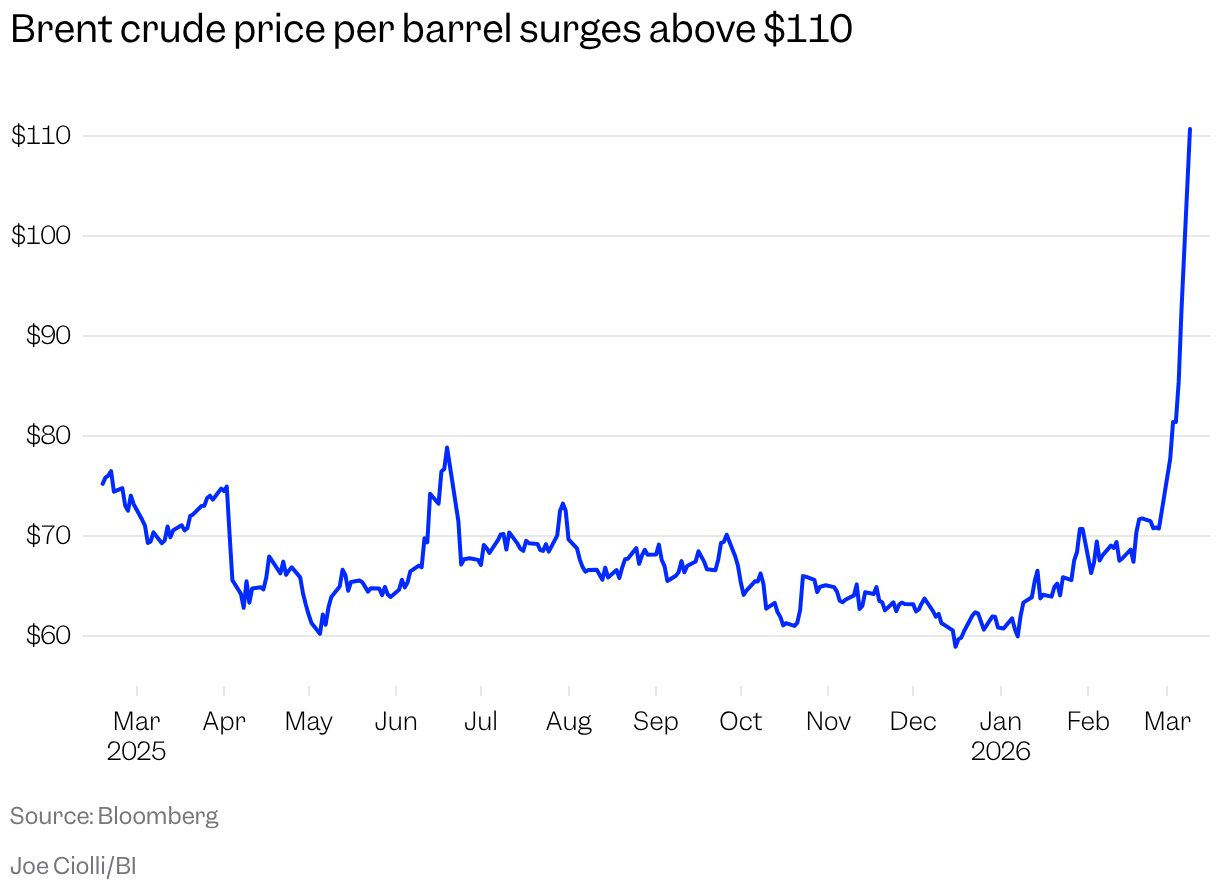
The narrative is the same one that sent crude prices nearly 30% higher last week: as long as the Iran war rages on — and as long as countries in the Middle East continue to cut production — prices will move higher.
The focal point has been the Strait of Hormuz, which handles a fifth of the world’s oil flow. Yet, as regional disruption has persisted, the scope of concerns has expanded to the entire global oil logistics network.
José Torres, a senior economist at Interactive Brokers, told BI last week that $100 would mark a true price shock for oil, leading to persistently high inflation and a possible down year for stocks. (The equity market already started feeling that pressure last week.)
Morgan Stanley CIO Mike Wilson — one of the most bullish stock strategists on Wall Street — has also been eyeing $100 as the level where he’d lower his base-case scenario for stocks this year.
If oil keeps rising, market pros have said to expect more trouble.
“$120 for Brent, you’re at zero growth. That’s the trigger for a recession,” Bruce Richards, the CEO of Marathon Asset Management, said last week. “That’s what I believe. And I believe that’s what the markets believe, although no one said it yet.”
The spillover: dollar gains and stocks slump
The prospects of an oil price shock and its fallout on global economic growth spread through the markets.
On Sunday evening, the greenback jumped to a three-month high against the euro and gained as much as 0.4% against the Japanese yen.
The US Dollar Index was 0.6% higher as of 8:47 p.m. ET.
The stronger dollar weighed on dollar-denominated commodities, even the haven trade in gold. The spot gold price was 2.5% lower at $5,043.93 per troy ounce.
All three main US stock market futures were about 2% lower.
Stock markets in Asia started the week deep in the red, with Japan’s Nikkei 225 losing as much as 6.5% in early trade. South Korea’s Kospi slumped by over 7%. Australia’s ASX200 lost 4%.
Asia is a major energy importer and is especially exposed to the disruption in oil supplies.